search
0
abb.4-Training-mit-leerem-Eisbad-aus-analyse-berg-sommer-2023

This post is also available in: German

Blog post created by
Christina Schwann

Date: June 30, 2026

Reading time: 12 min

You can also find this article in the Summer 2023 issue of the ÖKAS trade magazine *analyse:berg* #25.
Subscribe to *analyse:berg*. That way, you’ll have the magazines conveniently delivered to your home as soon as they’re published, while also supporting the work of ÖKAS.

A report on medical care for athletes at the 2023 World Mountain and Trail Running Championships in Innsbruck-Stubai.

Benedikt Treml
General and Surgical Intensive Care Unit, University Clinic for Anesthesiology and Critical Care Medicine, Innsbruck

Beatrix Schobersberger
Specialist in Internal Medicine, Gastroenterology, and Hepatology; Sports Scientist

Wolfgang Schobersberger
Institute for Sports, Alpine Medicine, and Health Tourism (ISAG), Tirol Kliniken Innsbruck UMIT Tirol, Private University for Health Sciences and Technology, Hall/Tyrol

Introduction

Trail running and mountain running are growing in popularity worldwide. The International Trail Running Association (ITRA) defines trail running as running in nature. Runs take place both in the mountains as classic mountain runs and on constantly changing terrain in various environments—such as forests, plains, deserts, hills, and snow-covered slopes—away from paved roads. An “ultra run” is defined as a race over a distance longer than the classic marathon distance of 42.195 kilometers. World Athletics, the international governing body for track and field, recognized trail running as an official discipline in 2015.

There are no predefined distances or elevation changes in the competitions, and there are no limits on the topographical conditions. As a result, it is not possible to compare the individual events with one another.

The competitions are based on the concept of self-sufficiency, which means that athletes must be self-reliant in terms of equipment, communication, food, and drink between aid stations.

From June 6 to 10, 2023, the World Mountain and Trail Running Championships (WMTRC) took place in the Innsbruck-Stubaital region. This is only the second time—after the 2022 event in Chiang Mai, Thailand—that mountain and trail runners have held their world championships together. The WMTRC consists of title competitions organized by the ITRA, the World Mountain Running Association (WMRA), and the International Association of Ultrarunners (IAU), and is coordinated by World Athletics (WA).

Over the four days of competition, a total of 1,600 runners from 68 countries competed. The flagship event, the Trail Long, featured an impressive course length of 86.9 kilometers and 6,500 meters of elevation gain, running from Neustift through the Kalkkögel mountains in the Stubai Valley to Innsbruck.

Mark Twain

Medical Concept

On behalf of World Athletics, we—Wolfgang Schobersberger as medical director, Benedikt Treml as deputy, and Beatrix Schobersberger as sports physician—were responsible for providing medical care to the athletes during these World Championships. In the run-up to the event, we ran through all possible scenarios that could arise at such an outdoor event.

Above all, we prepared for the “worst-case scenario”—ground evacuation in the event of unfavorable flying conditions. The rescue team that was assembled was impressive. The following were on duty for the Trail Long:

→ 56 mountain rescuers in the field
→ 1 mountain rescue incident commander
→ 5 mountain rescuers on standby
→ 3 ambulances, staffed by “mountain-ready” emergency physicians
→ 2 ambulances at the start/finish line
→ 3 emergency physicians
→ 3 sports medicine specialists
→ 9 paramedics
→ 1 Red Cross operations manager in the finish area

The goal was to ensure not only emergency medical care but also sports medicine care. To be prepared for any eventuality at the finish line, we had set up two ice baths for immediate treatment of participants suffering from heatstroke caused by exertion.

We wondered whether an ice bath is actually necessary for treating a possible heat shock in Tyrol, or whether it was an overreaction on the part of World Athletics to require it. These thoughts crossed our minds especially as we waited in the pouring rain at the finish line in Neustift on Thursday for the last athlete in the Trail Short race. Every day, we discussed the weather forecasts with the following questions in mind:

→ What are the expected maximum temperatures?
→ What is the humidity level?
→ What criteria are used to assess the athletes’ workload?

abb.1-Kühlgrenztemperatur-aus-analyse-berg-sommer-2023

Fig. 1: The “cooling limit temperature” (WBGT) depends on air temperature and humidity. Because the calculation formula is complex, simplified reference tables are available. The table shown applies to conditions of full sunshine and a light breeze.

A Side Note on the Weather

The risk of heatstroke due to physical exertion increases significantly at temperatures above 21 degrees Celsius and relative humidity of 50 percent. Heat stress can be estimated using the somewhat cumbersome term “cooling limit temperature” (syn. wet-bulb temperature) or, in English, “wet-bulb globe temperature (WBGT).”1 This was originally developed in the 1950s by the U.S. military, as heat-related deaths occurred with increasing frequency in the 1940s and 1950s.

When the ambient temperature exceeds 35 degrees Celsius, our bodies cool themselves primarily through evaporation. If the humidity rises above 75 percent, this evaporation process becomes less effective, increasing the risk of heatstroke. The cooling threshold temperature cannot be calculated exactly, but there are approximate formulas (Fig. 1).

(Fig. 2) shows the weather conditions in Innsbruck during World Championship week. On Saturday, the final day of the World Championships, the Mountain Classic took place under bright sunshine; temperatures at the finish line were measured at 27 degrees Celsius with 40 percent humidity, and the WBGT was 25 degrees, rising to 26 degrees Celsius after noon. As a guide, World Athletics provides a table in its medical handbook for competitions to assess the risk of heatstroke during exercise based on the “cooling threshold temperature” (Fig. 3).

Fig. 2: Air temperature, dew point, and relative humidity from the Innsbruck University weather station. The red arrows indicate the conditions during the mountain races on Saturday at noon. Source: Geosphere Austria | Fig. 3: Risk of heat-related injuries.
Source: Competition Medical Guidelines for World Athletics Series Events 2

Report from the Mountain Classic on the fourth day of competition

The Mountain Classic (Innsbruck) program featured a total of four competitions:

Round 1

→ 7.5 km: Å} 374 m elevation gain for junior boys
→ 7.5 km: Å} 374 m elevation gain for junior girls

Round 2

→ 15 km: approx. 377 m elevation gain for men
→ 15 km: approx. 377 m elevation gain for women

We lined up behind the finish line: four to five doctors tasked with identifying athletes who appeared to be in distress. But what does “in distress” mean? We agreed that any athlete who was unresponsive for more than thirty seconds, staggered across the finish line, or was unable to get back up from the ground would be escorted by us to the medical tent.

Then it began—the first men in the junior division crossed the finish line. It took less than five minutes before the first disoriented athlete was brought to us in the medical tent. After a brief neurological assessment (What’s your name? Where do you live? Which race did you run? What city are you in?), the suspected diagnosis was heatstroke.

There was no time for lengthy discussions; nearly all eight stretchers in our tent were now occupied. The first available resource—whether a doctor or a paramedic—was needed immediately, because the order was: off to the ice bath. How impressive: After just a few minutes, there was a rapid improvement in the athlete’s neurological condition. The junior skier is lifted out of the ice bath and taken to a quieter area in the tent.

But time was running out; in the meantime, the junior women’s race had already started. So we had thirty minutes left to clear out the occupied beds in the tent. We quickly gave fluids to an athlete who hadn’t drunk enough and had collapsed, and we treated another athlete’s low blood sugar with glucose tablets.

Finally, ten minutes before the next finish, we were able to discharge the last patient, who was accompanied by a caregiver. We quickly filled out the paperwork—at least to some extent—took a brief break, and headed back out to the finish line.

A Side Note on Heat Stroke

Exercise-related heatstroke is the second leading cause of death among young athletes. During intense exercise in a hot environment, the body can no longer adequately regulate this massive heat stress. The resulting systemic inflammatory response can cause multiple organ failure and, in some cases, lead to death.

In addition to a core body temperature of > 40 degrees Celsius, an altered mental state is typical. However, this neurological dysfunction can manifest in a variety of ways. Confusion, bizarre behavior, drowsiness, apathy, unsteady gait, disorientation regarding time and place, aggression, etc. Those affected may or may not sweat. A flushed face, rapid pulse, and rapid breathing are also not definitive signs.

The problem is this: Although the mortality rate from exercise-related heatstroke among young athletes is only < 5 percent, every minute spent > at 40 degrees can lead to permanent brain damage, kidney failure, and liver damage.

Aggressive cooling is the treatment of choice. At major events, ice-water baths and wading pools are available for athletes to cool off.3 In alpine terrain, a heatstroke victim can be cooled with cold water from a stream or river. If there are enough people and suitable equipment available—such as a blanket—and the patient is not having seizures, the patient can also be immersed in the cold water.

Heat Exhaustion Among Our Athletes

Shortly thereafter, the junior women began crossing the finish line. This time, things got underway immediately; from the top 10, we rushed two athletes straight to our makeshift first-aid station. One athlete was staggering dangerously. A quick neurological check revealed nothing out of the ordinary; we suspected dehydration rather than heatstroke.

In the meantime, another athlete was carried into the tent wrapped in a rescue blanket. She was thrashing about wildly and was unresponsive: the diagnosis of heatstroke was clear. There were only two of us left because our medical tent was already full again. We reacted immediately and took the young athlete’s rectal core temperature as soon as she was carried in: 41.5 degrees Celsius. All theory went out the window, because every minute > 40 degrees Celsius increases the mortality rate. We acted quickly and immediately transferred our patient to an ice bath. Even the chief medical officer of the World Athletics Federation had to lend a hand and fetched 20 kg of ice from the freezer outside the tent. Within a minute of being in the ice bath, our patient stopped thrashing about. But her temperature remained high. Only after another agonizingly long minute did her temperature finally begin to drop; after five minutes, it reached 40.5 degrees Celsius. And lo and behold, we were able to talk to the athlete normally again. Interestingly, it would take another ten minutes before we reached a “safe” 38.5 degrees Celsius. The athlete barely felt cold, even though the water temperature was about four degrees. Shortly afterward, we lifted the athlete out of the ice bath and moved her to a quieter area for further observation. After another thirty minutes, the athlete showed no neurological abnormalities, had not cooled down any further, and we were able to discharge her along with her coach. Of course, not without advising her to refrain from competitions for at least two weeks.

An hour later, we asked the women’s team where she was. A young woman we didn’t know turned around and told us that it had been her. It was unbelievable—now that her temperature had returned to normal, there was no sign left of the life-threatening situation from an hour earlier.

The event continued in a similar vein as the elite-class athletes sprinted across the finish line. At least we were seeing fewer heatstroke cases now, and just the usual issues: open heels and blisters, scrapes on knees and elbows, low blood sugar, dehydration, etc. But eventually our tent emptied out, and, exhausted, we were able to take stock of the medical care provided at this World Championship.

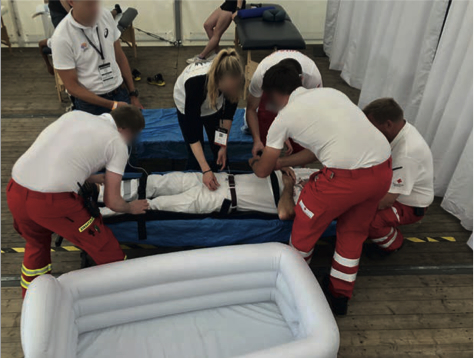
Fig. 4: Training with an empty ice bath. The simulated patient is positioned on the stretcher on a mesh rescue sheet to facilitate lifting him into and out of the ice bath. This requires four people. | Fig. 5: Fictitious patient during training in the empty ice bath. The simulated rectal temperature probe is visible in the foreground on the left. A long towel is looped through the armpits; a medical professional uses this to hold the athlete at the head end, thereby preventing the head from submerging. This person also continuously monitors the athlete’s neurological status.
Photos: Authors

Appeal

It was an exciting experience, because we hadn’t expected so many cases of heatstroke caused by physical exertion. Especially given that the air temperature was 27 degrees Celsius.

That is why we urge you: Even in alpine regions like Tyrol, exertional heatstroke can occur—whether you’re playing American football in the city or hiking in the mountains.

The most important thing is to always keep this in mind! If someone shows neurological symptoms in the heat, you should cool them down quickly even if you only suspect heatstroke. If the symptoms disappear once they’re cooled down, it was heatstroke.

Thank you

… the World Championship organizer, Alpine Trailrun Festival GmbH (Mag. Alexander Pittl), for the excellent organization.

… our medical partners at World Athletics—Dr. Stèphane Bermon, Dr. Paolo Emilio Adami, and Frederic Garrandes—who introduced the three of us to the fascinating topic of heatstroke as “mountain medicine specialists.”

… to all mountain rescuers and emergency responders who were on duty every day.

… Alex Radlherr from GeoSphere Austria for his excellent processing of the measurement data!

Bibliography

1 Yaglou, C., & Minard, D. (1957). Control of heat-related illnesses at military training centers. *Archives of Industrial Health*, 16:302–316.

2 Adami, P., Bermon, S., Garrandes, F., & Guadagnini, G. (2020). Competition Medical Guidelines for World Athletics Series Events: A Practical Guide. 2nd ed. World Athletics. Monaco.

3 Racineis S, Hosokawa Y, Akama T et al. 2023. IOC Consensus Statement on Recommendations and Regulations for Sports Events in Hot Weather. Br J Sports Med 57(1):8–25.