This post is also available in:
You can also find this article in the summer 2025 issue of the ÖKAS trade magazine analyse:berg. Become a subscriber to analyse:berg. You will receive the magazine conveniently delivered to your home as soon as it is published and support the work of ÖKAS at the same time.
Of the three fatal mountaineering accidents in the period under review, one occurred in January during an ice tour in combined terrain due to an avalanche. The other two accidents occurred in classic alpine touring terrain with two things in common: The starting point for both was the Kürsinger Hütte (2,548 m) and both were not private tours but guided tours – one was a guided club tour and the other was a course for mountain guide training. Below are the reports from the Alpine Police.
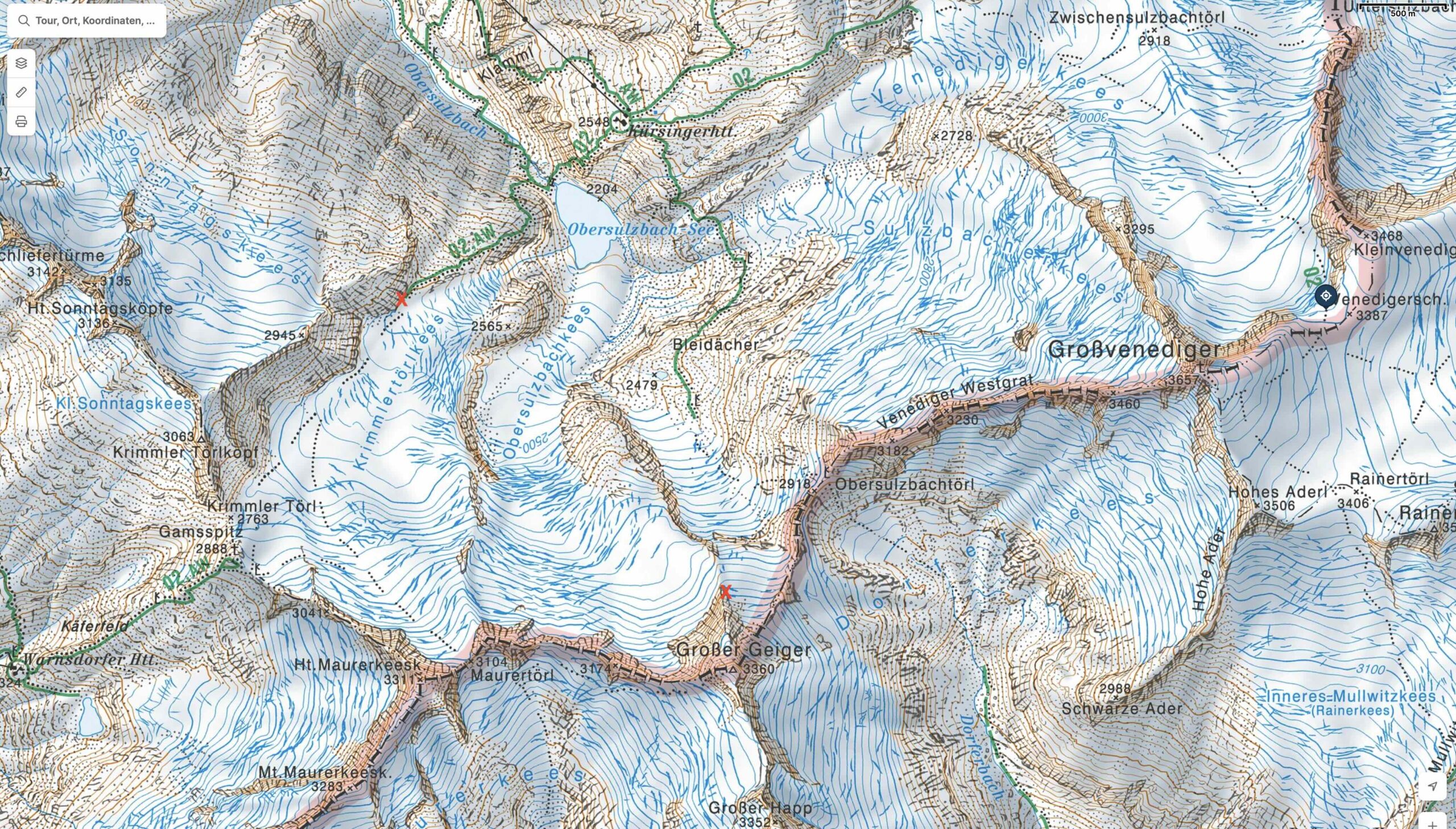
Fig. 1: The locations of the two fatal mountaineering accidents. On June 29, 2024, an aspirant on a training course to become an Austrian mountain and ski guide fell fatally on the north ridge of the Großer Geiger (3,360 m) after a rope break. On August 13, 2024, a participant on a guided ÖAV tour died after falling unroped into a covered edge crevasse on the descent.
Map: Federal Office of Metrology and Surveying | © BEV, CC BY 4.0, data.bev.gv.at
Lead climbing fall with rope break,
North ridge Gr. Geiger/Venediger group on 29.06.2024
Siegfried Berger
Police mountain guide, head of Alpine Operations Group (AEG) Zell am See
Course of the accident
On Saturday, June 29, 2024, a 26-year-old Austrian was a mountain guide aspirant on a training course in Obersulzbachtal (municipality of Neukirchen, Salzburg). The plan was to climb the Grosser Geiger (3,360 m) via the north ridge, which has to be mastered in easy climbing up to difficulty level III (UIAA). The aspirant had been given the task of guiding his instructor to the summit on the rope using the correct belay technique.
At around 08:30, the main difficulties were already behind the rope team. The rest of the route led over easier terrain in difficulty levels I-II (UIAA). In accordance with the training guidelines, the aspirant positioned his instructor – who simulated the role of a guest – on an eight to ten square meter platform in such a way that he was protected against possible rockfall. The route ahead was clearly visible and easy to assess. Of the 50 meters of rope he carried for guiding, he used around ten meters for belaying – the rest was stowed on his body or in his rucksack.
After he had climbed about two to three meters upwards, a boulder measuring approx. 100×50×20 centimetres slipped from under his feet, causing him to lose his balance. His instructor – who was in the supposedly safe area without a self-belay – was able to grab the rope with his hands, but was unable to prevent the fall. After he felt a violent jolt, the rope was severed.
The instructor immediately rushed to the fallen man, who was lying motionless in the scree about 50 meters away. He managed to lift away a large block of stone lying on top of the aspirant and begin the necessary rescue measures. However, the emergency doctor who arrived by helicopter was only able to determine that he had died.
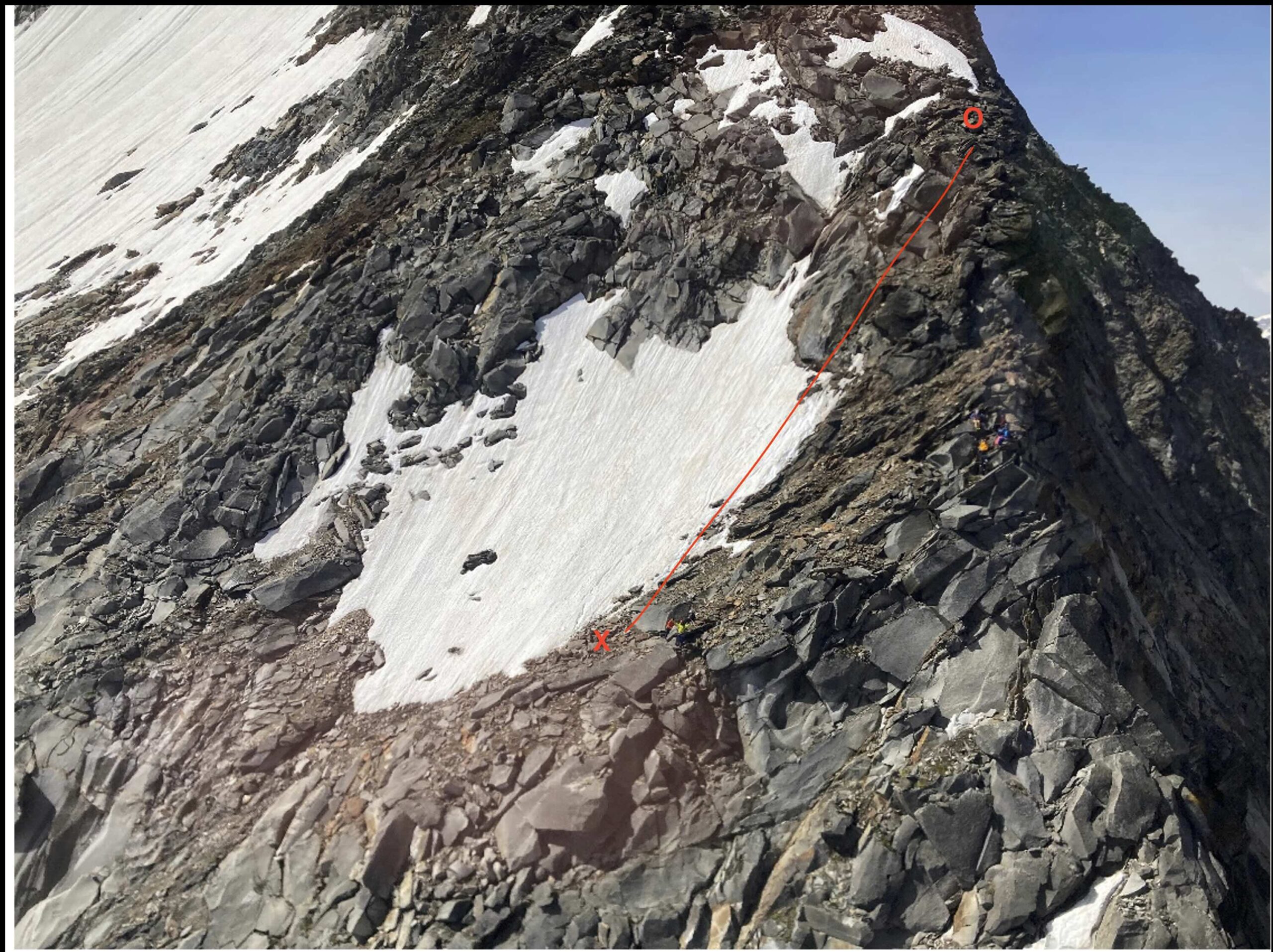
Fig. 2: The accident site on the north ridge of the Hoher Geiger from the helicopter. The aspirant's fall site and the fall path after the rope broke twice, as well as his final position, are shown. The instructor and two other aspirants are there to provide first aid and instruct the helicopter. The remaining group members and other aspirants with their instructors, who were also on the ridge, are visible on the ridge.
Photo: Alpine Police
Rescue and recovery measures
Immediately after the crash, an emergency call was made from the scene of the accident and the emergency helicopter (NAH) Martin 6 (Martin Flugrettung, Heli Austria) was dispatched. An alpine police officer from the Neukirchen/Großvenediger police station then carried out the initial investigations.
After the emergency doctor from the ambulance was only able to determine the death of the accident victim, the Libelle Salzburg police helicopter recovered the body.
Survey result