This post is also available in:
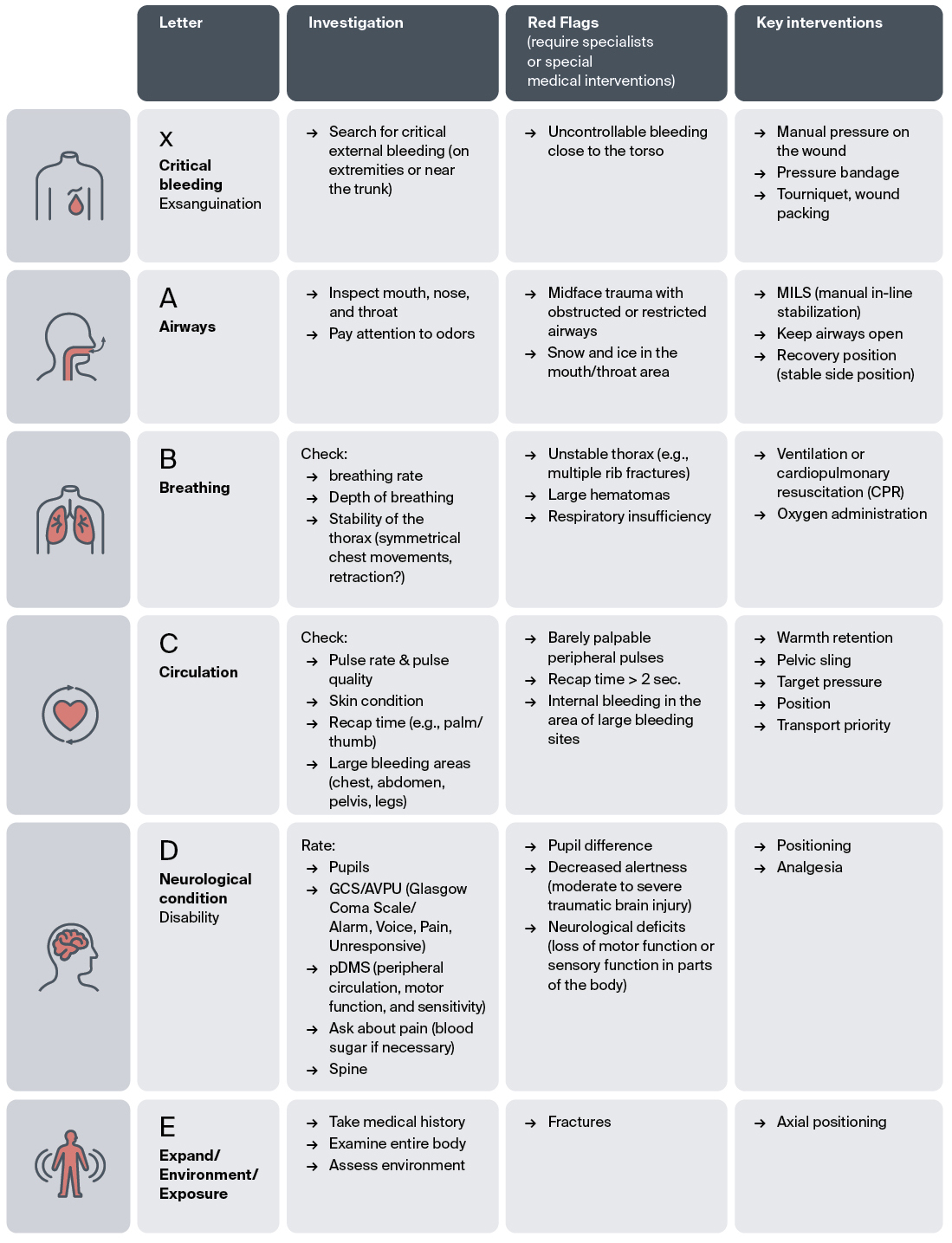
The ABCDE scheme is a standardized method used by the emergency services to assess and treat an emergency patient. It is also taught in adapted versions to laypersons and first aiders so that they can take the first relevant first aid measures until professional help arrives on the scene. This algorithm is also being trained by more and more organizations in the Alpine region. One of the reasons for this development in German-speaking countries is Philipp Dahlmann. In 2017, he and his team of authors began publishing a 13-part (!) first aid series in the magazine bergundsteigen, making a plea for the use of this scheme for female mountaineers. The scheme was well received by these potential first aiders – at last they had a comprehensible algorithm that they could work through – but not so much in the professional world at first: it was too complicated, too complex and in some cases recommended things that had not been decided on by the expert committees. That’s true, because for us mountaineers and mountain guides there are no expert committees that think about how we should deal with an injured person in the terrain. In the meantime, everyone has – almost – become friends again and is working together constructively. However, there is still no xABCDE scheme that has been created specifically for female mountaineers and their requirements. So we asked Philipp, who is also an ÖKAS expert member, to formulate and justify such a tailor-made scheme. This was long overdue and the team of authors Katharina Helm and Philipp Dahlmann will be addressing the individual points in the next issues of analyse:berg. But first, let’s start with an overview of xABCDE.
Katharina Helm
NotSan HEMS and practical instructor (Germany),
B.Sc. student rescue pedagogy, PHTLS instructor,
trainer at the ADAC HEMS Academy
Philipp Dahlmann
Certified paramedic (Switzerland),
Post-doc in the field of rescue sciences
First of all: This article is aimed at ÖKAS members and analyse:berg readers.
We assume that they have already received alpine first aid training and are curious to understand the background and develop things further. In line with the ÖKAS motto: “Those who know nothing must believe everything” (Marie von Ebner-Eschenbach).
What is xABCDE?
To answer this question, we briefly present the most relevant publications and their key messages:
xABCDE is a scheme in acronym form that enables structured and standardized examination and care. It is equally suitable for simple and complex events or emergencies so that nothing is forgotten or overlooked. It is already prioritized.
👉 Schmid, B., Sauer, F. & Busch, HJ. Preclinical initial assessment at the scene. Bundesgesundheitsblatt. 65, 979-986 (2022), https://doi.org/10.1007/s00103-022-03582-3
xABCDE is an aid to structured diagnostics and therapy for patients.
👉 Peran, D., Kodet, J., Pekara, J. et al. ABCDE cognitive aid tool in patient assessment – development and validation in a multicenter pilot simulation study. BMC Emergency Medicine 20, 95 (2020), https://doi.org/10.1186/s12873-020-00390-3
xABCDE is the foundation or basis for efficient patient care. It simplifies interdisciplinary communication because it is used both pre/post-hospital and in-hospital.
👉 Müller, HJ, König, H. & Prescher, T. Work process orientation in the vocational training of emergency paramedics. Emergency Rescue Medicine 23, 1-15 (2020), https://doi.org/10.1007/s10049-019-0612-2
The xABCDE scheme has been empirically confirmed and is therefore evidence-based.
👉 Thim T., Krarup, Grove, Rohde, Løfgren B. Initial assessment and treatment with the Airway, Breathing, Circulation, Disability, Exposure (ABCDE) approach. International Journal of General Medicine, Vol. 5 (2012), https://doi.org/10.2147/IJGM.S28478
Why does xABCDE make sense?
Emergency situations in alpine areas pose complex challenges for private individuals, rescue teams and medical personnel. The terrain, general conditions and current weather conditions make access to the injured person difficult and the available resources are often limited.
Stress and uncertainty in emergency situations can also lead to important measures in patient care being overlooked. A structured and simple framework for action, such as the xABCDE acronym, helps to proceed in a standardized manner and to retain free cognitive resources in action while being able to concentrate on the essentials.The scheme offers the possibility of working through both simple and complex situations in a targeted manner, as it already prioritizes the individual body regions according to their urgency. This structure also ensures that no essential aspects are overlooked or neglected (Peran, et al. 2020 and Schmid, Sauer, Busch 2022).
With the help of the xABCDE scheme, you can simply start from A again if the situation changes. This provides certainty of action, particularly in the case of a patient who collapses during treatment (ERC guidelines).
At the same time, the standardized procedure promotes interdisciplinary communication between pre/outside clinical and clinical actors, as the scheme is universally applied (Müller, König and Prescher 2020). There is also a common language for first responders (companion rescuers, BLS personnel such as piste or mountain rescuers) and ALS personnel, which is particularly important for handover.
This article examines the use of the scheme in the context of alpine accidents and its usefulness as an intuitive guide to action.