search
0
Hochtourenunfaelle-Karte-anaylse-berg-sommer-2025

This post is also available in: German Czech Polish

You can also find this article in the summer 2025 issue of the ÖKAS trade magazine analyse:berg. Become a subscriber to analyse:berg. You will receive the magazine conveniently delivered to your home as soon as it is published and support the work of ÖKAS at the same time.

Of the three fatal mountaineering accidents in the period under review, one occurred in January during an ice tour in combined terrain due to an avalanche. The other two accidents occurred in classic alpine touring terrain with two things in common: The starting point for both was the Kürsinger Hütte (2,548 m) and both were not private tours but guided tours – one was a guided club tour and the other was a course for mountain guide training. Below are the reports from the Alpine Police.
Hochtourenunfaelle-Karte-anaylse-berg-sommer-2025

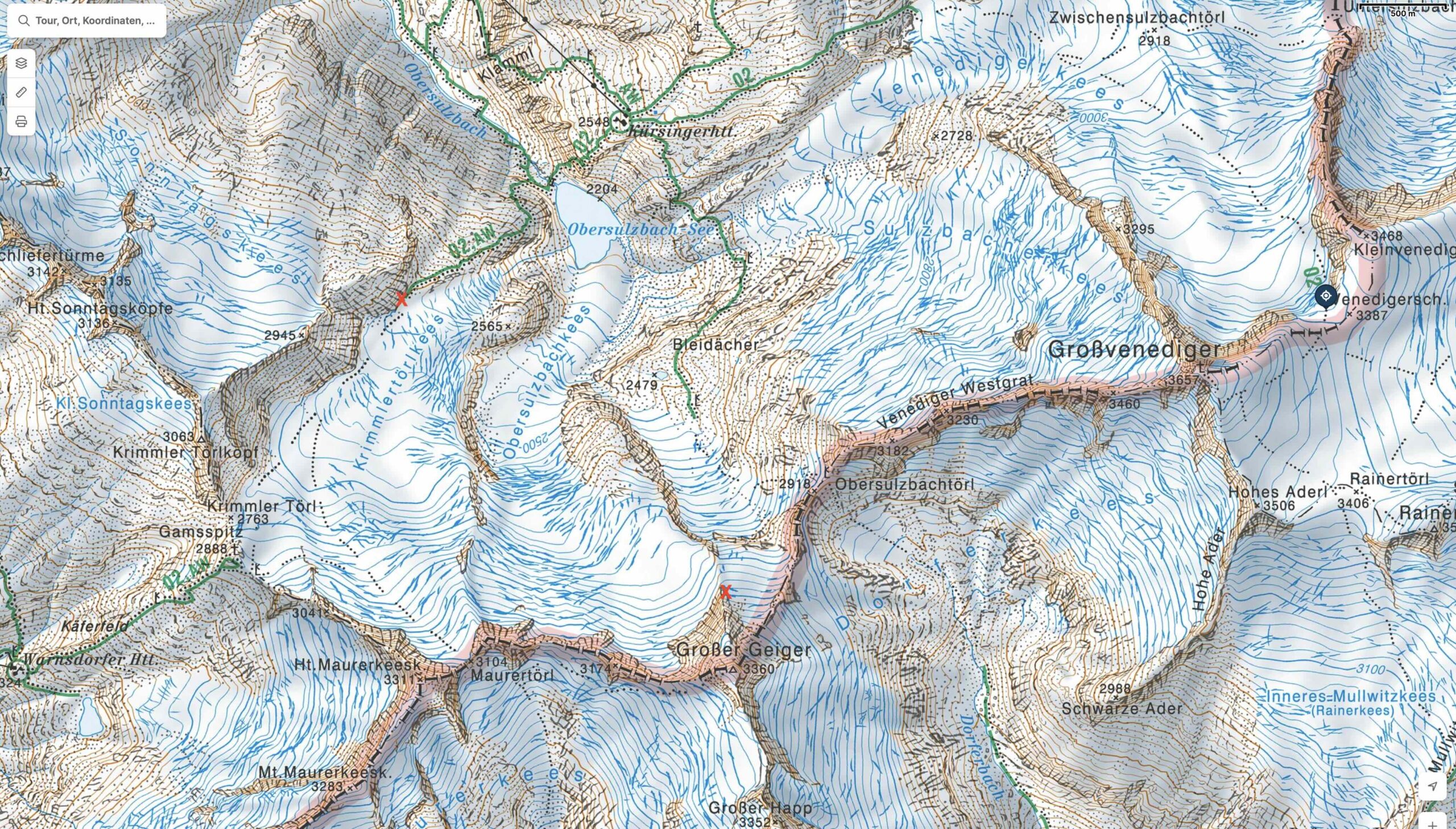
Fig. 1: The locations of the two fatal mountaineering accidents. On June 29, 2024, an aspirant on a training course to become an Austrian mountain and ski guide fell fatally on the north ridge of the Großer Geiger (3,360 m) after a rope break. On August 13, 2024, a participant on a guided ÖAV tour died after falling unroped into a covered edge crevasse on the descent.
Map: Federal Office of Metrology and Surveying | © BEV, CC BY 4.0, data.bev.gv.at

Lead climbing fall with rope break,
North ridge Gr. Geiger/Venediger group on 29.06.2024

Siegfried Berger
Police mountain guide, head of Alpine Operations Group (AEG) Zell am See

Course of the accident

On Saturday, June 29, 2024, a 26-year-old Austrian was a mountain guide aspirant on a training course in Obersulzbachtal (municipality of Neukirchen, Salzburg). The plan was to climb the Grosser Geiger (3,360 m) via the north ridge, which has to be mastered in easy climbing up to difficulty level III (UIAA). The aspirant had been given the task of guiding his instructor to the summit on the rope using the correct belay technique.

At around 08:30, the main difficulties were already behind the rope team. The rest of the route led over easier terrain in difficulty levels I-II (UIAA). In accordance with the training guidelines, the aspirant positioned his instructor – who simulated the role of a guest – on an eight to ten square meter platform in such a way that he was protected against possible rockfall. The route ahead was clearly visible and easy to assess. Of the 50 meters of rope he carried for guiding, he used around ten meters for belaying – the rest was stowed on his body or in his rucksack.

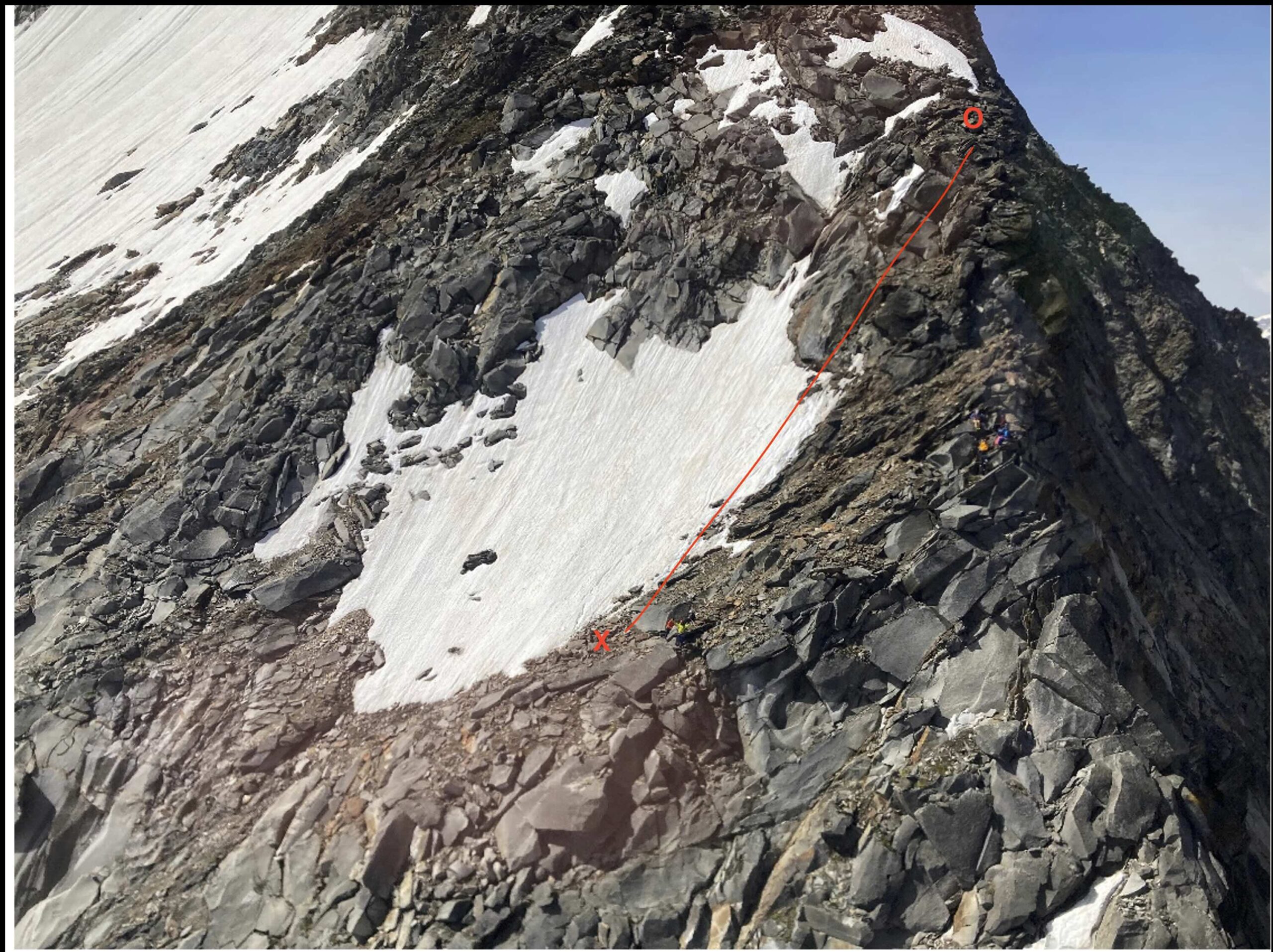
After he had climbed about two to three meters upwards, a boulder measuring approx. 100×50×20 centimetres slipped from under his feet, causing him to lose his balance. His instructor – who was in the supposedly safe area without a self-belay – was able to grab the rope with his hands, but was unable to prevent the fall. After he felt a violent jolt, the rope was severed.

The instructor immediately rushed to the fallen man, who was lying motionless in the scree about 50 meters away. He managed to lift away a large block of stone lying on top of the aspirant and begin the necessary rescue measures. However, the emergency doctor who arrived by helicopter was only able to determine that he had died.
Unfallstelle-nordgrat-hoher-geiger-analyse-berg-sommer-2025

Fig. 2: The accident site on the north ridge of the Hoher Geiger from the helicopter. The aspirant's fall site and the fall path after the rope broke twice, as well as his final position, are shown. The instructor and two other aspirants are there to provide first aid and instruct the helicopter. The remaining group members and other aspirants with their instructors, who were also on the ridge, are visible on the ridge.
Photo: Alpine Police

Rescue and recovery measures

Immediately after the crash, an emergency call was made from the scene of the accident and the emergency helicopter (NAH) Martin 6 (Martin Flugrettung, Heli Austria) was dispatched. An alpine police officer from the Neukirchen/Großvenediger police station then carried out the initial investigations.

After the emergency doctor from the ambulance was only able to determine the death of the accident victim, the Libelle Salzburg police helicopter recovered the body.

Survey result
A training course for Austrian mountain and ski guides consisting of 42 aspirants took up quarters at the Kürsinger Hütte (2,548 m) on June 28, 2024. A number of lectures were held on the same day, including on the topic of “guiding techniques”, which was the subject of the tour planned for the next day. The participants were then allocated to the instructors and the equipment was checked. The accident victim’s group consisted of him and the instructor as well as four other participants, making a total of six people.

Finally, the tour for the next day had to be planned. As the weather was forecast to be stable, the decision was made to go on an 11-hour tour. It was decided in detail who would do which tasks and when. The departure was scheduled for around 05:00. Some of the participants were already familiar with the tour and the requirements corresponded to their level of training.

In addition, a GPS track was created of the route that was to lead from the Kürsinger Hütte via the north ridge to the Gr. Geiger.

The day of the tour began as planned and they found excellent conditions at the start of the ridge. The aspirant knew the ridge from an ascent two weeks earlier and did an excellent job as lead guide. He mentioned that it was much more difficult back then in winter conditions. A little later, the accident described above occurred, which could only be observed directly by the instructor. Another participant saw a stone slip, which subsequently caused even more material to move. The others only heard the incident and one participant immediately called the emergency services.

Further surveys

At 12:20 p.m. on the day of the accident, the Salzburg public prosecutor’s office was informed of the accident and at 4:20 p.m. commissioned an expert to carry out the findings and prepare an expert opinion. At the same time, an autopsy and a chemical toxicology examination were ordered.

On June 30, 2024, an alpine police officer and the expert carried out further investigations at the scene of the accident. The detailed results were subsequently forwarded by the expert to the public prosecutor’s office.

–>

To the expert opinion
After the investigations based on the expert opinion were discontinued, the commissioned expert Walter Siebert was able to present this case and his assessment to his colleagues as part of the ÖKAS expert training 2025. You can read a brief summary of this on page 153, where you will also find the link to the corresponding digital conference proceedings on the ÖKAS website, including accident sketches etc.

The expert found two breaks in the accident rope – an Edelrid Swift Protect Pro Dry 8.9 mm (see p. 136) – a tear and a cut by a stone (the rope was also cut several times during the first aid measures).

In his expert opinion, Walter Siebert cites the probable cause of the crash and the rope cracks: “One possible cause is that a strong rope pull pulled the lead climber off balance. This rope pull can (only) be explained by the fact that the rope was wrapped around a slipping boulder […] This is also supported by the rope damage caused by the impact of rocks. If the lead climber had shortened the rope to approx. 10 m between him and his instructor/guest, the rope damage is in the right position to first pull the lead climber from his standing position and then cause the unusually strong rope pull on the instructor/guest. The rockfall marks also indicate that several rocks have fallen. If the rope was lying in loops on slipping rocks, it may well have become entangled in them.”

To summarize, he concludes: “The aspirant crashed under his own influence. The cause of the fall was a chain of unfortunate events. […] It can be assumed that the instructor/guest would also have been pulled down by the rope if the rope had not broken beforehand.”

Randkluftsturz,
Krimmlertörlkees/ Venediger group on 13.08.2024

Johannes Wurzer
Police mountain guide, Zell am See police station

Course of the accident

On Tuesday, August 13, 2024, a 10-person touring group from the Austrian Alpine Club Murau section led by two tour guides was on a high-altitude tour in the rear Obersulzbachtal valley. They were descending from the Gamsspitz (2,888 m) via the Krimmlertörlkees and were at the transition from the glacier to a marked trail (approx. 2,570 m) at around 12:10 when a 54-year-old participant broke into a crevasse covered with old snow (firn) – a crevasse at the transition from the glacier to the rock. His companions were unable to make visual or call contact with him and made an emergency call.

After an extensive rescue operation involving the Neukirchen/Großvenediger and Prägraten/Großvenediger mountain rescue teams as well as the Alpine Police, the Austrian Army and two BMI helicopters, the casualty could only be rescued dead from a depth of approx. 18 meters at 6:15 pm.

Survey result and recovery measures

The ÖAV group, led by two tour guides, was on a multi-day alpine tour at the Kürsinger Hütte (2,548 m) in the Venediger Group.

The day before, they climbed the Großvenediger together, and on August 13, 2024, a final tour to the Gamsspitz (2,888 m) and the descent into the valley was planned. Already during the ascent, the later accident site, an edge crevasse covered with old snow, was entered and crossed individually after checking the tour guides, whereby the snow cover withstood the strain. The glacier was climbed roped up in two groups.

On the descent – a few meters before leaving the glacier – these rope teams were broken up and, after checking the old snow cover again, the same edge crevasse was crossed again individually. After three climbers – including a tour guide – had crossed the edge crevasse, part of the snow cover collapsed on the fourth participant. He fell 18 meters, followed by loose scree and large boulders. A tour guide – who still had a rope to hand for safety – managed to throw his rope to another participant who was also in danger of falling into the edge crevasse and save her from falling.

As there was no visual or call contact with the victim, an emergency call was made and a large-scale rescue and recovery operation began. The traumatized but uninjured remaining tour participants were flown from the accident site to the valley by the BMI helicopters and cared for by a Red Cross crisis intervention team.

Rescuing the fallen victim proved to be very difficult due to the risk of rockfall from sliding boulders. The regional geologist Gerald Valentin (also a mountain guide and expert) was therefore flown to the accident site to assess the situation. Subsequently, the boulders were anchored to the solid rock with steel anchors, steel cables and pins using a considerable amount of material and under adverse external conditions. Only when the danger of sliding material had been reduced to an acceptable level could rescue workers be lowered into the edge crevasse. The man who had fallen was found at a depth of around 18 meters, his body was largely covered in snow and rubble and a boulder weighing around 300 kilograms was lying on his upper body. Due to the way he was found, it can be assumed that he died instantly.

The body was recovered at 18:30 and flown down to the valley by the Libelle Salzburg (BMI) police helicopter and handed over to the mortician. The relatives of the deceased were informed of his death in person.

The coroner’s inquest was carried out by the district physician at 7 p.m. on the day of the accident, whereupon the Salzburg public prosecutor’s office released the body.

Fig. 3: The accident site with the edge crevasse at the transition from the glacier to the marked route. After the two glacier rope teams had abseiled down on the bare glacier, three climbers crossed the existing old snow field (white) to the marked trail one by one, as they had done earlier on the ascent. A part of the snow bridge collapsed on the fourth participant and he fell a fatal 18 m into the edge crevasse (photo above). It was a major challenge for the rescue team to secure the loose scree and boulders so that the body could be recovered (photo below).
Photos: Alpine Police

Links & Publications:

ekas_analyse-berg_abo_2025
Never miss an issue:
2 x per year, in winter & summer incl. shipping:
within Austria: € 40,-
EU, GB, CH: € 46,-
* compared to individual purchase
to the subscription